

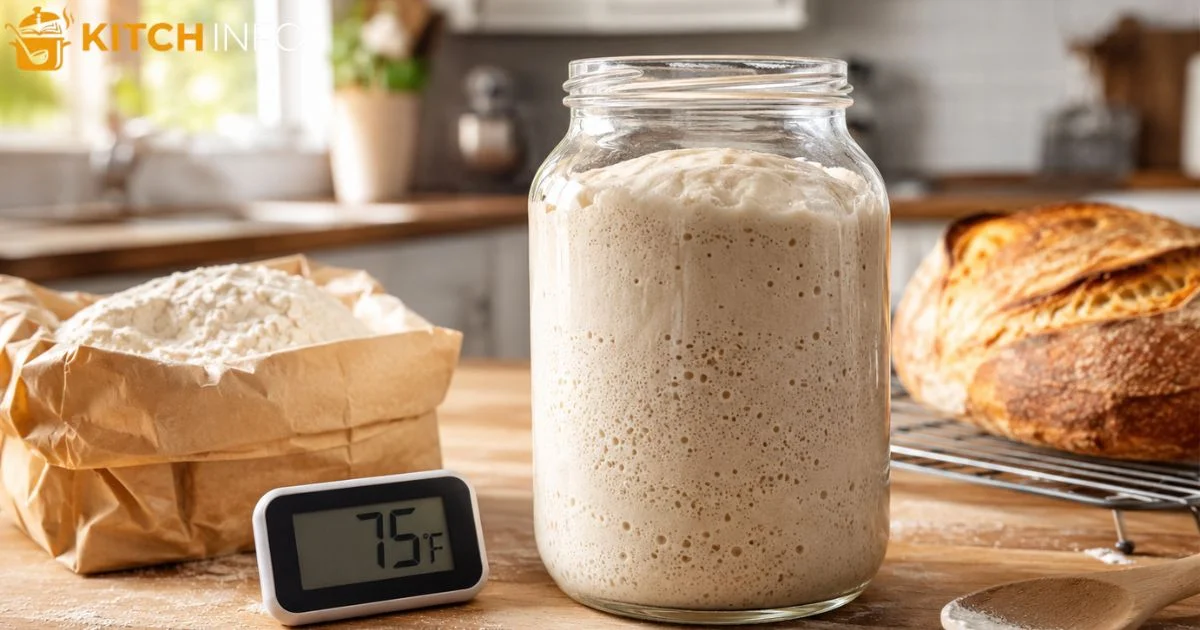
How long can sourdough starter sit out? A healthy sourdough starter can usually sit out at room temperature for 24 to 48 hours without feeding, depending on your kitchen conditions. If it has been recently fed and remains an active starter with a bubbly starter, it is generally safe to use. However, leaving it out too long without feeding weakens the wild yeast and beneficial bacteria that keep the culture healthy. A well maintained sourdough culture made from flour and water stays strong with regular care. Knowing how long can sourdough starter sit out helps you prevent spoilage, maintain a healthy starter, and enjoy consistent results every time you bake delicious homemade sourdough bread.
How Long Can Sourdough Starter Sit Out
If you have ever wondered how long can sourdough starter sit out, the answer depends on several important factors. A healthy sourdough starter is a living culture made from flour and water that naturally grows wild yeast and beneficial bacteria. These tiny organisms work together to create the rise, flavor, and texture that make homemade sourdough so special.
Many home bakers leave their starter on the kitchen counter because it is easier to monitor and feed regularly. Others keep it in the fridge when they bake less often. Both methods work well, but the amount of time a starter can safely remain at room temperature changes based on how active it is, how warm your kitchen is, and when it was last fed.
In most American homes, a healthy starter can stay on the counter indefinitely if it follows a consistent feeding routine. However, if it is left without fresh food, the microorganisms slowly consume the available nutrients. Eventually, the culture weakens and may no longer produce reliable bread.
For a freshly fed active starter, the strongest fermentation usually happens within 4 to 6 hours after feeding in a warm kitchen. During this period, the starter reaches its peak activity and is often ready for baking.
If a starter sits out without another feeding, it usually remains healthy for about 24 to 48 hours in average indoor conditions. Some strong cultures can continue longer, but they gradually lose strength as the food supply runs out.
Many experienced bakers find that a starter can survive for 6 to 18 hours after reaching its peak without major problems. It may become more acidic and less powerful, but it is often still usable after another feeding.
A neglected starter left on the counter for maximum 3 days may still recover if there are no signs of spoilage. Recovery simply requires several fresh feedings before using it again for baking.
Every starter behaves a little differently because every kitchen has its own environment. That is why sourdough baking often involves a little trial and error. Learning how your own starter responds is one of the best skills a baker can develop.
What Determines How Long It Can Stay at Room Temperature

No two starters behave exactly the same way. Even if two people use the same recipe, one starter may stay active much longer than another. Several factors influence how long the culture remains healthy before it needs another feeding.
Kitchen temperature makes the biggest difference
The temperature inside your home has a major effect on fermentation.
A warm temperature speeds up yeast activity. The microorganisms eat through their food much faster, causing the starter to rise quickly before collapsing sooner.
A cold temperature slows everything down. The starter develops more gradually and usually stays stable for a longer period before another feeding becomes necessary.
For many American kitchens, temperatures between 68 and 75 degrees Fahrenheit create a comfortable balance for maintaining a healthy culture.
The type of flour matters
Different flours provide different nutrients for fermentation.
Many bakers use bread flour because it creates a dependable and predictable starter. Others prefer wholegrain flour, which contains more natural nutrients that help microorganisms multiply quickly.
Whole grain contains the bran, endosperm, and germ, giving the culture additional minerals and vitamins that encourage strong fermentation. Because of these extra nutrients, starters made with whole grain often become active sooner than those made only with refined flour.
Some bakers use strong white flour for everyday maintenance because it produces a mild flavor while remaining easy to work with.
Feeding schedule affects strength
A starter that follows a regular feeding schedule remains healthier than one that is fed only occasionally.
When you feed starter consistently, you replace the food that the yeast and bacteria have already consumed. This keeps the microorganisms balanced and energetic.
A neglected culture becomes hungry. As fermentation continues without new flour, the acidity increases, making it harder for the yeast to stay strong.
Many people who keep their starter on the counter choose to feed every day so the culture stays ready for baking whenever needed.
Hydration influences fermentation
The amount of water in the mixture also changes how quickly fermentation happens.
A thinner starter often ferments faster because the microorganisms move more freely through the mixture.
A thicker starter usually develops more slowly and may stay stable a little longer between feedings.
Both methods work well as long as the feeding routine remains consistent.
Container choice plays a role
The container itself does not change fermentation, but it affects cleanliness and airflow.
A glass jar makes it easy to watch the starter expand and monitor bubble formation.
Many bakers prefer transferring the culture into a clean jar every few feedings. This reduces dried residue around the sides and makes it easier to spot any unusual growth.
The container should never be sealed tightly during active fermentation. Instead, many people use a loosely covered jar that allows gas to escape while protecting the culture from dust.
Some bakers use a lightweight lid placed gently on top rather than tightening it completely.
Water quality can affect growth
Most municipal water supplies work well for sourdough, but heavily treated water sometimes slows fermentation.
If your local tap water contains a strong chlorine smell, allowing it to sit uncovered for several hours before use may improve fermentation.
Some bakers also use filtered water if they notice consistently slow activity.
Starter maturity changes everything
A newly created starter behaves differently from an established one.
Young cultures may appear active one day and weak the next because the microorganisms are still developing balance.
An older sourdough culture becomes much more stable over time. Once fully mature, it usually handles changes in feeding and temperature more easily.
Many experienced bakers affectionately call their mature starter mother yeast because every future loaf begins with this living culture.
Signs Your Sourdough Starter Is Still Safe to Use

Leaving a starter on the counter for a day or two does not automatically mean it has gone bad. Instead of relying only on time, learn to recognize the signs of a healthy culture.
It still has bubbles
One of the easiest signs is visible bubbles throughout the mixture.
These bubbles show that the yeast and bacteria are still producing carbon dioxide. Even if the starter has already fallen after reaching its highest point, bubble activity often continues.
A bubbly starter is usually still alive and capable of recovering with another feeding.
It has a pleasant aroma
Healthy starters rarely smell bad.
Most produce a slightly tangy scent with hints of yogurt, apples, or vinegar. Some develop a gentle fruity flavour that becomes more noticeable after regular maintenance.
The smell may become stronger when the starter is hungry, but it should never smell rotten.
It rises after feeding
One of the clearest indicators of a healthy culture is how it responds after fresh flour and water are added.
During the feeding process, the microorganisms receive new nutrients and begin multiplying again.
A healthy starter rise should become noticeable within several hours.
Many bakers watch for the point where the starter doubles in size, which shows strong fermentation and good yeast activity.
It passes the float test
Some bakers perform the float test before mixing dough.
A small spoonful of starter is placed into lukewarm water. If it floats, enough gas has become trapped inside the culture to indicate good activity.
Although this test is popular, it is not always perfect. A starter can still make excellent bread even if it sinks, especially if it was tested after beginning to collapse.
It responds to repeated feedings
A hungry starter often becomes active again after one or two fresh feedings.
If the culture quickly produces bubbles and rises predictably, it is usually healthy enough for baking.
Sometimes a neglected starter needs several feedings before reaching full strength again.
It maintains a normal appearance
Healthy starter usually has a creamy texture with no unusual colors.
The surface may become slightly dry if left uncovered for too long, but that alone does not mean it has spoiled.
Some liquid may collect on top after sitting for an extended period. This is a natural byproduct of fermentation and can usually be mixed back in or poured off before feeding.
When a Sourdough Starter Goes Bad

Although sourdough starters are surprisingly resilient, they are still living cultures. Eventually, poor storage or contamination can cause the balance of microorganisms to fail.
Recognizing the warning signs helps prevent unsafe baking.
Mold is the clearest warning
Visible mold means the starter should be discarded immediately.
Fuzzy growth in green, black, pink, orange, or white colors indicates contamination that cannot safely be removed by scraping off the surface.
Once mold appears, the entire starter should be thrown away.
Unpleasant odors signal trouble
A hungry starter often smells sharp or acidic, and that is completely normal.
However, foul odors that resemble rotten food, spoiled meat, or decay suggest harmful contamination.
These smells are very different from the natural sour aroma expected in healthy fermentation.
Strange colors should never be ignored
Healthy starter usually remains cream colored, beige, or light brown depending on the flour used.
Bright streaks, unusual spots, or colorful patches suggest unwanted microbial growth.
If you notice these changes, it is safest to start over with a fresh culture.
No activity after multiple feedings
Sometimes a starter appears normal but never regains strength.
If several days of regular feeding produce no bubbles, no rise, and no signs of life, the yeast population may have died.
In that situation, creating a new starter is often easier than trying to save the old one.
Extremely old neglected starters
Many online stories describe starters surviving months without attention.
While this is sometimes possible, results vary widely depending on storage conditions.
A starter forgotten on the counter for several weeks is much more likely to become contaminated or lose enough yeast activity that recovery becomes difficult.
What to Do If It Has Been Left Out Too Long
Finding your starter on the counter after forgetting about it can feel frustrating, but it does not always mean you need to throw it away.
The first step is to inspect it carefully before making any decisions.
| Time Left Out | Typical Condition | Recommended Action |
| Up to 24 hours | Usually healthy | Feed normally and continue using |
| 24 to 48 hours | Hungry but often recoverable | Feed and monitor activity |
| Around 3 days | Weak but may recover | Feed several times before baking |
| More than several days | Depends on appearance and smell | Inspect carefully before deciding |
| Mold or unusual colors | Unsafe | Discard immediately |
Examine the starter carefully
Look for mold, unusual colors, or unpleasant smells.
If everything appears normal, there is a good chance the culture simply needs fresh food.
Visual inspection is always more reliable than judging by time alone.
Refresh the culture
Many bakers choose to discard starter before feeding.
Removing part of the old mixture reduces acidity and gives the remaining microorganisms fresh nutrients.
Then refresh starter by adding new flour and water according to your usual ratio.
Watch how the culture responds over the next day.
Give it multiple feedings if necessary
A neglected starter may not recover after only one feeding.
Two or three consecutive feedings often restore strength by rebuilding the yeast population.
Once the starter consistently rises and develops plenty of bubbles, it is usually ready for baking again.
Wait before making bread
Avoid baking immediately if the culture still seems sluggish.
Instead, continue feeding until it rises predictably after each feeding and reaches its normal peak.
This extra patience usually produces much better sourdough bread with improved texture and flavor.
Know when to begin again
Sometimes recovery simply is not possible.
If the starter develops mold, persistent bad odors, or never shows any signs of fermentation after repeated care, replacing it is the safest choice.
Fortunately, creating a new starter requires only flour, water, and a little patience, making it easy to begin the process again before moving on to proper long term storage and maintenance practices.
Counter Storage vs Refrigerator Storage

One of the biggest decisions every home baker makes is whether to keep a starter on the counter or store it in the refrigerator. The best choice depends on how often you bake and how much maintenance you want to do.
If you bake several times a week, keeping the starter on the counter is usually the most convenient option. The culture stays active and is ready with regular feedings.
If you only bake once a week or less, cold storage is often the better choice. Lower temperatures slow fermentation, allowing the starter to remain healthy with much less attention.
Keeping a starter on the counter
A starter kept at kitchen temperature stays active every day. This makes it easier to prepare dough whenever you want to bake.
Regular care is important because the microorganisms continue using the available nutrients throughout the day. Missing several feedings can weaken the culture over time.
This method works well for people who enjoy frequent sourdough baking and want their starter ready at almost any time.
Keeping a starter in the refrigerator
Refrigeration slows fermentation dramatically. Instead of feeding every day, many home bakers only need to refresh their starter before baking.
A common routine is to remove the starter one day before baking, feed it, allow it to become active, and then prepare the dough.
After baking, the remaining starter can be fed again and returned to the refrigerator until the next bake.
Some healthy starters can remain refrigerated for maximum 2 weeks between feedings, although many bakers prefer refreshing them weekly for the best performance.
Which storage method is better
Neither method is better for everyone.
Counter storage offers convenience for frequent baking, while refrigeration reduces maintenance for occasional bakers.
The most important goal is consistency. A starter that follows a regular routine stays healthier than one that is constantly switched between different schedules.
How Temperature Affects Starter Stability
Temperature controls nearly every stage of fermentation.
Even small changes inside your home can affect how quickly your starter grows, becomes hungry, and needs another feeding.
When conditions become warmer, yeast activity increases. The starter rises faster but also uses its food more quickly.
Cooler conditions slow fermentation, helping the culture remain stable for a longer period.
Because every home is different throughout the year, many bakers adjust their feeding routine during seasonal weather changes.
During summer, a starter may need more frequent care.
During winter, fermentation often slows naturally, so the starter may take longer to become fully active.
Paying attention to your starter instead of relying only on the clock is one of the most reliable ways to maintain a healthy culture.
Tips to Keep Your Sourdough Starter Healthy
Healthy starters are usually the result of simple, consistent habits rather than complicated techniques.
Here are some practical tips that help keep a starter strong over the long term.
Use consistent feeding amounts
Keeping similar feeding ratios each time creates a predictable routine for the microorganisms.
Large changes in flour or water amounts can temporarily affect fermentation and make the starter less predictable.
Keep equipment clean
Clean containers and utensils help reduce unwanted contamination.
A fresh container every so often also makes it easier to monitor the condition of the starter.
Watch for activity instead of the clock
Every kitchen is different.
Rather than feeding strictly by the hour, pay attention to how your starter behaves. A culture that rises well and develops good fermentation is usually ready for its next step.
Feed before making dough
For the strongest results, always feed the starter before mixing bread dough.
Using a healthy culture at its peak produces better rise, improved texture, and more dependable baking results.
Save extra starter
Many bakers like keeping a backup.
A dry starter is easy to prepare and stores well for emergencies.
Others create a dried starter by spreading a thin layer onto parchment paper and allowing it to dry completely before storing it in an airtight container.
Some bakers even prepare extra starter as a thoughtful sourdough starter gift for friends and family who want to begin baking.
Common Mistakes That Reduce Starter Life
Even experienced bakers occasionally make mistakes.
Fortunately, most problems are easy to avoid once you understand what your starter needs.
Skipping too many feedings
A culture left without enough food gradually becomes weaker.
Although sourdough is remarkably resilient, repeated neglect eventually reduces yeast activity.
Using dirty containers
Old residue left inside containers increases the chance of unwanted contamination.
Regular cleaning helps keep the starter healthy.
Changing flour too often
Frequently switching between different flour types can temporarily change fermentation speed.
While experimenting is perfectly fine, making changes gradually usually produces more predictable results.
Ignoring visual changes
A healthy starter gives clear signs about its condition.
Watching its rise, texture, and smell helps you recognize small problems before they become serious.
Baking with a weak starter
Using a sluggish starter often leads to dense loaves with less oven spring.
Allowing the culture to fully recover before baking usually produces much better bread.
Conclusion
Knowing how long can sourdough starter sit out helps you care for your starter with confidence and avoid unnecessary waste. A healthy starter is surprisingly durable, but it performs best when it receives regular feedings and is stored in conditions that match your baking routine.
Whether you keep it on the counter for frequent baking or in the refrigerator between baking sessions, paying attention to its appearance, aroma, and activity is far more valuable than relying only on the calendar. With a simple routine and a little observation, your starter can remain healthy for years and continue producing flavorful homemade sourdough bread whenever you are ready to bake.
FAQS
What happens if I leave sourdough starter out too long?
It becomes weak, overly acidic, and may eventually develop mold or spoil.
How long can sourdough starter sit out at room temperature?
A healthy sourdough starter can usually sit out for 24 to 48 hours before it needs feeding.
Can a sourdough starter go bad from sitting?
Yes, if left unfed for too long, it can weaken, grow mold, or become contaminated.
How long can sourdough starter last unrefrigerated?
With regular feedings, it can stay unrefrigerated indefinitely, but without feeding it is best refreshed within 24 to 48 hours.
What is the biggest mistake you can make with your sourdough starter?
The biggest mistake is leaving it unfed for too long, which weakens the yeast and reduces its baking performance.

Muhammad Ali writes about baking and recipes at kitchinfo. He researches techniques from trusted bakers, cookbooks, and culinary experts, and turns them into clear, step-by-step guides . so bakers of every skill level can get great results without the confusion.